Will Richardson mentions this recently.
I have been thinking a lot about how learning objects like CLIPS can be precise and concise at the same time.
Did you get through all that?
Showing posts with label CLIPs. Show all posts
Showing posts with label CLIPs. Show all posts
Wednesday, May 19, 2010


Thursday, March 11, 2010
Regular Expressions in Actionscript 2
Regular Expressions are a powerful method of working with text strings based on dynamic patterns. For example, you might want to extract all the numbers from a string like "Michael travels 550km in 6.2 hours using 40L of gasoline", or replace any occurrence of "INV" followed by an arbitrary number of alphanumerics followed by a space with "- reference removed -".
Regular Expressions are useful in parsing user input or creating grammars for strings.
Flash decided not to support a RegExp class in Actionscript 2, though it is implemented in Actionscript 3, Javascript, and JScript.
Pavils Jurjans bemoaned this fact and created his own RegExp class for Flash 5, which was encapsulated by Joey Lott into a .as file for Actionscript 2. Pavils also created a very handy tester, which together with websina's page, helped me to get started with regular expressions.
The CLIPS programmers have started to use our version of the class, which has been documented with ZenDocs, and includes a trim, rtrim, ltrim and slightly modified replace method. A simple tester .fla is available to interact with the class.
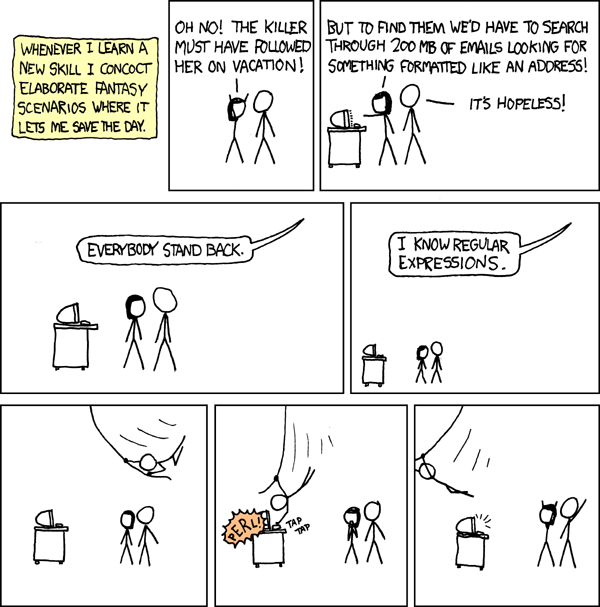
I probably feel as excited learning this new skill as the fellow in this xkcd.com comic.

Regular Expressions are useful in parsing user input or creating grammars for strings.
Flash decided not to support a RegExp class in Actionscript 2, though it is implemented in Actionscript 3, Javascript, and JScript.
Pavils Jurjans bemoaned this fact and created his own RegExp class for Flash 5, which was encapsulated by Joey Lott into a .as file for Actionscript 2. Pavils also created a very handy tester, which together with websina's page, helped me to get started with regular expressions.
The CLIPS programmers have started to use our version of the class, which has been documented with ZenDocs, and includes a trim, rtrim, ltrim and slightly modified replace method. A simple tester .fla is available to interact with the class.
I probably feel as excited learning this new skill as the fellow in this xkcd.com comic.
Tuesday, May 19, 2009
Representations of Linear Growing Patterns Cluster Launched
It is with a lot of pleasure that I am able to announce the launch of a new cluster of CLIPS.
Representations of Linear Growing Patterns is based on research conducted by Ruth Beatty at the Institute for Child Studies in Toronto. Although it does not flesh out the experiences that students would have in Grades 4-6 with concrete materials, it certainly alludes to them. Students take pictorial representations, based on coloured tiles, of a pattern and develop graphical representations and algebraic rules. They then explore the role of the constant and multiplier in the pattern rules. One Near North teacher blogged about the change it made in her understanding and about her experience trying it in her classroom.
Among the material created for the cluster are a graphing tool and an open-ended tool to explore the relationships between the representations, including stories and the algebraic equation. The graphing tool is described carefully in Clip 2, Activity 4: Practice Graphing. The Rainbow DSB is conducting a "book study" of this cluster. I hope that soon we can feature some innovative ways to use the Exploring Representations tool resulting from their work. I am hoping to engage the Web 2.0 math teacher community to address the question "What can we do with this?".

The cluster movie is quite different from the "Who Cares?" movies developed for Fractions and Periodic Functions. The overview movie, which should be viewed after working through the development, summarizes the cluster nicely.
There are several improvements to the CLIPS "wrapper", including the ability to set a volume level or mute that is respected throughout navigation and a new scene selector. The major videos can be viewed fullscreen without downloading a huge source file. Trish Steele narrates a new 12-minute introduction to the wrapper that is well worth the time.
Since the activities are primarily flash animations (SWF) with embedded narration, the files are relatively big. The design of CLIPS does not depend on any server technology. Teachers or students who wish to use the activities, but don't want to depend on an internet connection, can download the entire thing and point to the index.html file at the root, for local use.
We thought it would be done earlier and there are still some rough edges (please use the Feedback link at the top right to record anything that you notice) but we are very happy to now have the work officially in circulation.
Representations of Linear Growing Patterns is based on research conducted by Ruth Beatty at the Institute for Child Studies in Toronto. Although it does not flesh out the experiences that students would have in Grades 4-6 with concrete materials, it certainly alludes to them. Students take pictorial representations, based on coloured tiles, of a pattern and develop graphical representations and algebraic rules. They then explore the role of the constant and multiplier in the pattern rules. One Near North teacher blogged about the change it made in her understanding and about her experience trying it in her classroom.
Among the material created for the cluster are a graphing tool and an open-ended tool to explore the relationships between the representations, including stories and the algebraic equation. The graphing tool is described carefully in Clip 2, Activity 4: Practice Graphing. The Rainbow DSB is conducting a "book study" of this cluster. I hope that soon we can feature some innovative ways to use the Exploring Representations tool resulting from their work. I am hoping to engage the Web 2.0 math teacher community to address the question "What can we do with this?".

The cluster movie is quite different from the "Who Cares?" movies developed for Fractions and Periodic Functions. The overview movie, which should be viewed after working through the development, summarizes the cluster nicely.
There are several improvements to the CLIPS "wrapper", including the ability to set a volume level or mute that is respected throughout navigation and a new scene selector. The major videos can be viewed fullscreen without downloading a huge source file. Trish Steele narrates a new 12-minute introduction to the wrapper that is well worth the time.
Since the activities are primarily flash animations (SWF) with embedded narration, the files are relatively big. The design of CLIPS does not depend on any server technology. Teachers or students who wish to use the activities, but don't want to depend on an internet connection, can download the entire thing and point to the index.html file at the root, for local use.
We thought it would be done earlier and there are still some rough edges (please use the Feedback link at the top right to record anything that you notice) but we are very happy to now have the work officially in circulation.
Tuesday, October 14, 2008
The CLIPS uberCalculator launched!
I have had the privilege of working on the development of a set of learning objects supporting an instructional trajectory in Fractions, Periodic Functions and Linear Patterns, called CLIPS.
There has been a lot of effort to design a wrapper to complement these activities. One of the elements of this wrapper has been a simple calculator. Recently, Greg Clarke completely overhauled the CLIPS calculator to support four modes: Basic, Scientific, Graphing and Conversion. Greg was able to take advantage of the work of others who have freely shared their code in the opensource spirit. The calculator is available inside CLIPS by clicking its icon at the top right. It is also available standalone at www.oame.on.ca/clips/calculator.html. The URL can be appended with ?mode=basic or ?mode=sci or ?mode=graphing or ?mode=conv as above to jump directly to one of the versions. A drop-down list is used to switch between modes, open the calculator in another window (which makes it resizeable) and to download the .swf locally for offline use, perhaps on an interactive white board.
The CLIPS calculator is now prominently catalogued at the Mathfest wiki page of online calculators, which has lots of other interesting online tools listed.
One nice, inobtrusive feature is that when the equals sign is pressed, the answer is copied to the user's clipboard, ready to be pasted into an answer text field in CLIPS or wherever it might be required. I now have the CLIPS calculator as a link in my quick launch bar.

There has been a lot of effort to design a wrapper to complement these activities. One of the elements of this wrapper has been a simple calculator. Recently, Greg Clarke completely overhauled the CLIPS calculator to support four modes: Basic, Scientific, Graphing and Conversion. Greg was able to take advantage of the work of others who have freely shared their code in the opensource spirit. The calculator is available inside CLIPS by clicking its icon at the top right. It is also available standalone at www.oame.on.ca/clips/calculator.html. The URL can be appended with ?mode=basic or ?mode=sci or ?mode=graphing or ?mode=conv as above to jump directly to one of the versions. A drop-down list is used to switch between modes, open the calculator in another window (which makes it resizeable) and to download the .swf locally for offline use, perhaps on an interactive white board.
The CLIPS calculator is now prominently catalogued at the Mathfest wiki page of online calculators, which has lots of other interesting online tools listed.
One nice, inobtrusive feature is that when the equals sign is pressed, the answer is copied to the user's clipboard, ready to be pasted into an answer text field in CLIPS or wherever it might be required. I now have the CLIPS calculator as a link in my quick launch bar.

Friday, May 23, 2008
Applied 3D Geometry
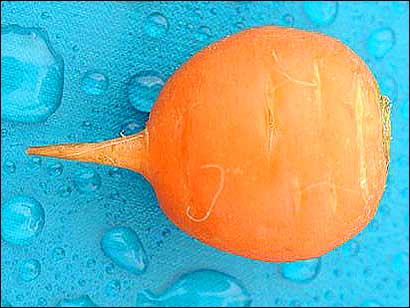
Isn't the internet a fascinating phenomenon? Today, the posting at one of my early favorite blogs is about square watermelons from Japan - oops cubical watermelons. I felt a twinge of incredulity, but found a hoax site that indicates that it is true and a video of a news clip at a popular video sharing site which means it is most certainly true. Apparently, there are also spherical carrots.

Over at my del.icio.us page, I have recently bookmarked several interesting 3D tools, including the one that my buddy Greg used to create the rotating model of an engine's pistons, called Sandy.

Incidently, the link above to the piston's example uses a new feature in CLIPS - the ability to link directly to a scene within an activity. It uses a fairly straightforward javascript technique which communicates to the flash object, but we were excited to be able to make it work. There is a link at the top of the scene to a sequence that describes how the engine works that is worth the trip.
Over at my del.icio.us page, I have recently bookmarked several interesting 3D tools, including the one that my buddy Greg used to create the rotating model of an engine's pistons, called Sandy.

Incidently, the link above to the piston's example uses a new feature in CLIPS - the ability to link directly to a scene within an activity. It uses a fairly straightforward javascript technique which communicates to the flash object, but we were excited to be able to make it work. There is a link at the top of the scene to a sequence that describes how the engine works that is worth the trip.
Friday, December 14, 2007
Monday, November 12, 2007
Flash Graphing Tools
As part of the CLIPs project, we have been developing learning objects in Flash to support work in the Grade 11 Functions courses. Fortuitously, we came across a set of robust tools created by Doug Ensley, Shippensburg University and Barbara Kaskosz , University of Rhode Island, funded in part by the National Science Foundation, which include fantastic documentation. We have learned a lot about programming in Flash by using the tools.
There has been some functionality that we wanted to add, including labeling of axes and adding control points to graphs that necessitated creating our own version of the classes. Examples of our work and the original examples are available here.

There has been some functionality that we wanted to add, including labeling of axes and adding control points to graphs that necessitated creating our own version of the classes. Examples of our work and the original examples are available here.

Subscribe to:
Posts (Atom)